Posts

Data Visualization

This video immediately reminded me of conversations I had had with a friend of mine. He was explaining his field of study in college. First off, he begins by saying that he is a cartographer. I.e., he studies and draws maps. This conversation occurred within a group of peers. One friend made the comment, "Well, isn't everything already mapped out?", another chimed in, "Yeah, so what would you really do in the workplace?". He laughed and explained that he got this reaction frequently. And that no, it's not really as simple as it seems and it's not an individual, isolated profession. He told of us an internship he had working for the city of Baltimore. His position included mapping out neighborhoods including concentrations of crime areas, vacant housing, and schools. This allowed the city office to identify where community centers were needed to hopefully decrease the rate of children and adolescents entering into crime. This is a primary example of data ...

A.I.

"The sad thing about artificial intelligence is that it lacks artifice and therefore intelligence." In keeping with the postmodern tradition, my project takes the emotion of the statement and transforms it into a visual display. The composition of the work is most close to a rule of thirds. There are varying different lines separating the piece into different sections, segregating some themes while creating a setting of congruence for others. The focal point of the piece is the white robot playing the violin. Though this figure is set back behind two barriers, it is the brightest color of the image thus the eyes are drawn there. One then follows the orange line to right noticing the contrast of the black and white figure on a colorful background with a warm explosion. Returning to the thick vertical line, one's eye path moves up toward the largest piece of the composition. Using Magritte's Midnight Marriage (1926) while adding a Black Right's movement individual...

Postmodernism

I found both of these articles extremely interested. Not only did they excite me for our next assignments in postmodernism, they brought up numerous questions regarding the movement. From the first article detailing an introduction to postmodernism, I was reminded of an excerpt I read this past spring prior to traveling to Rome. This introduction to postmodernism revealed to me that individuals across all areas of intellect can be considered postmodernists. The article that I read prior was written about Sigmund Freud on the history of Rome. I'm not sure exactly, but I believe this article written by Freud predated the postmodern yet illustrated similar views. I've linked this article to the views of the postmodern movement because Freud discusses Rome's history as a mental entity. It is characteristic of postmodernism to use hyperbolic metaphors to describe phenomena. The way that the Introduction to postmodernism text described an arts brochure for a major university an...

Radio Lab: Colors

I found this podcast to be the most entertaining and interesting of all the readings/videos assigned thus far. I enjoyed the narrators and how their personalities were illustrated through their discussion of colors. Additionally, I listened to it while driving back to Baltimore from Massachusetts. Not only was I able to put their words into context of the colors of the changing leaves on the trees tunneled in the highway but also the day fading into night as the world around glowed then darkened. I think what struck me about this podcast is how much the narrators describe color as being an individual process. What I understand through their discussion was that color depends on us. Is color a social construct? Though color may be an individual process, we all have shared notions of what we perceive to be red, green, purple, etc. Does this mean that color exists because we communicate about it? This phenomena reminds me of the tree falling in the forrest. The tree does still fall even ...

SUBVERTISEMENT

Image

Baltimore Museum of Art

Image
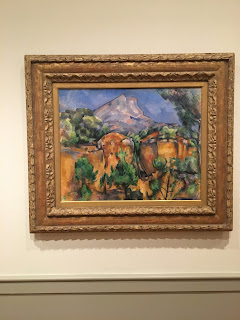
The first piece of artwork that piqued my interest was Paul Cezanne's  Mont Saeinte-Victoire  seen from Bibemus Quarry. This painting features a landscape but is quite different from the traditional landscape painting. Instead of being filled with organic lines illustrating true nature, Cezanne uses more of a geometric concept. The varying line quality gives the audience the perception of depth. In this painting, one can find the compositional elements of the vertical rule of thirds and radiating lines of the mountain structures below the main peak.  The second piece I selected was Georgia O'Keeffe's  Pink Tulip . This piece is a good example of rhythm. It is very easy to see the movement and flow of the flower. There is a clear and defined use of  organic lines, purposely mimicking nature. One can identify the compositional elements of the golden ratio spiral.  The third piece, of many, that was salient to me is William Lamb Picknell's  Paysa...

The Way of Seeing

This reading was very interesting to me. I found it especially interesting because I think that the text mirrors the point that the author is trying to convey. John Berger discusses "ways of seeing" and provides information about how when we look at artwork, we are looking at something through the lens of the artist. This text that we are reading, is through the lens of John Berger and his opinion on the subject. He even notes that the world is not objective but it is affected by our individual consciousness. Berger goes in depth to describe perspective which I find to be very helpful. Perspective is a term that I have been familiar with for a long time across a variety of subjects. This is why it helps to have it redefined specifically for the context of art. He states, "Perspective makes the single eye the centre of the visible world" (Berger, 16). This perspective is particularly ego-centric if carried over to every context but it makes sense for viewing and unde...